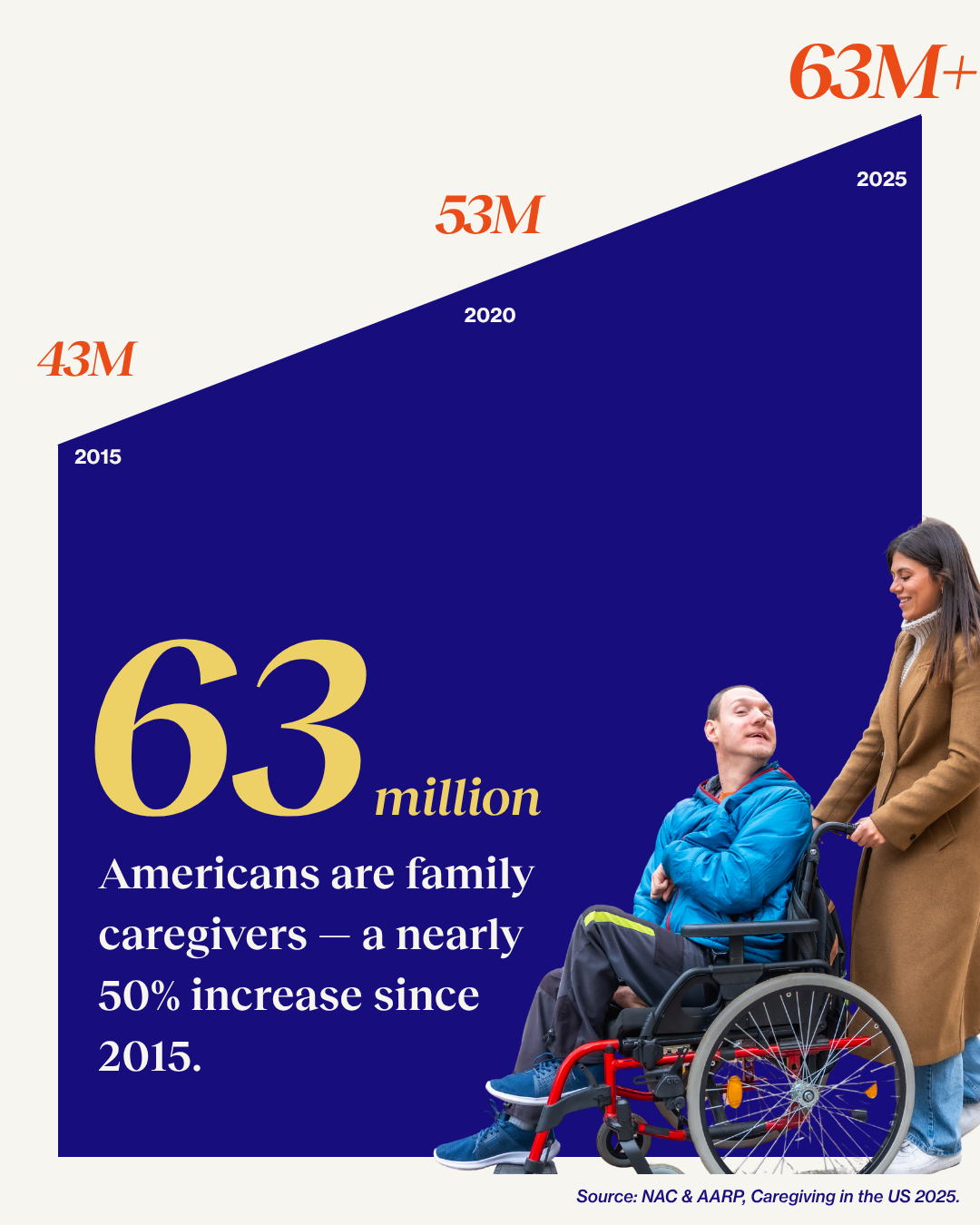
At the National Alliance for Caregiving (NAC), we leverage data to champion our nation’s 63+ million family caregivers who provide ongoing, complex care. By capturing the diverse experiences of caregivers nationwide, we empower researchers with robust data, a collaborative community, and meaningful pathways to transform insights into practical solutions.
In partnership with leading research institutions and the Administration for Community Living (ACL), we’re building a comprehensive data infrastructure to inform the development, assessment, and scaling of effective caregiver support programs for older adults. This approach ensures that national and state investments are evidence-based and deliver maximum impact to family caregivers.
Introducing the CARE Network
The Creating and Advancing Caregiving Research and Evidence (CARE) Network is a collaborative initiative focused on building a unified and adaptable national infrastructure for family caregiving research and data sharing across the National Family Caregiver Support Program (NFCSP) and the Native American Caregiver Support Program (NACSP) network.
This network brings together interdisciplinary researchers, aging services providers, family caregivers, and experts in caregiving, aging, and disability to advance Goal 5 of the National Strategy to Support Family Caregivers – expanding data, research, and evidence-based practices to support family caregivers.
Most importantly, the CARE Network centers the voices of family caregivers to ensure activities are co-created with, and meet the diverse needs of, family caregivers and the programs that serve them. 
The CARE Network Resource Hub
One key component of the CARE Network is developing a Resource Hub to provide tools that help caregiving researchers and service providers engage in research more effectively. Leading this effort is Dr. Regina Shih, Professor of Epidemiology at Emory Rollins School of Public Health. We asked Dr. Shih to share insights about this important initiative:
 What inspired the initiative to create a Resource Hub?
Family caregiving data, research, and interventions have blossomed over the past few decades, but we recognized that research and programs could coordinate their efforts more efficiently. The initiative was inspired by the need to build a national infrastructure to systematically collect, analyze, and share family caregiving data, research, and interventions.
The goal is to inform practice improvements and service delivery across the NFCSP and NACSP networks while aligning efforts with the National Strategy to Support Family Caregivers.
What types of resources will the Resource Hub feature?
We’ve carefully designed the Resource Hub to be comprehensive yet practical. Our goal is to create resources that bridge the gap between research and implementation. The Resource Hub will include several key components. First, researchers will find a Data Resources Matrix that provides a summary of available family caregiving data. This will be accompanied by a Compendium of Evidence-Based Interventions, which not only catalogs interventions but also analyzes their strengths, limitations, and potential for adaptation across different contexts.
Additionally, we’re developing a curated list of common caregiving data measures complete with technical assistance materials. To support practical implementation, we’ll develop comprehensive implementation guides along with a recorded walkthrough video that highlights key features of the guides and addresses common questions to help organizations scale these interventions across various settings and populations.
Who is the Resource Hub designed to support?
We’ve intentionally designed the Resource Hub to serve multiple stakeholders within the caregiving ecosystem. Our vision is to create a central knowledge base that breaks down silos between research and practice.
The Hub will benefit family caregiving researchers who support older adults and people with chronic health conditions, but its reach extends much further. Aging service providers will find practical tools they can implement in their programs. Community organizations serving caregivers will discover resources to enhance their local impact. And policymakers will find the data needed to inform evidence-based decision making. 
At its core, the Resource Hub is designed to strengthen knowledge translation, promote intervention scaling, and inform evidence-based caregiving support across the entire spectrum of stakeholders who touch the lives of family caregivers.
When will the Resource Hub be available?
We’re taking a methodical approach to development and release. We’re planning a phased rollout of resources via the National Caregiver Support Collaborative website beginning in early 2027. This timeline allows us to align the releases with our project milestones and ensure each component receives thorough testing and refinement before public release.
While this timeline reflects our current plan, we’re exploring ways to provide previews and early access opportunities for CARE Network participants. We want to balance thoroughness with accessibility.
How can researchers and others help support the Resource Hub?
This initiative will truly thrive through active participation from the broader caregiving research and practice communities. We’re building something that will evolve and grow stronger with engagement.
There are several meaningful ways to contribute. First and foremost, we invite researchers and practitioners to participate in CARE Network activities, which will provide regular updates about the Resource Hub’s development and opportunities for input.
For those directly involved in research, adopting and promoting the tools being developed is encouraged. As researchers incorporate these standardized approaches into their work and publish peer-reviewed caregiving research using these resources, it strengthens the entire knowledge base.
There will also be ongoing learning opportunities. We’re planning regular webinars and communities of practice focused on scaling evidence-based interventions. These interactive sessions will allow for knowledge exchange and collaborative problem-solving around implementation challenges. Together, we’re building a future where data and research on family caregivers can accelerate meaningful change across America.

This project is supported by the Administration for Community Living (ACL), U.S. Department of Health and Human Services (HHS) as part of a financial assistance award totaling $2,664,000 with 75 percent funded by ACL/HHS and $664,000 and 25 percent funded by non-government source(s). The contents are those of the author(s) and do not necessarily represent the official views of, nor an endorsement, by ACL/HHS, or the U.S. Government.”
Authors: